- Yaro on AI and Tech Trends
- Posts
- 🎤Davos has AI on Stage, Trump in the Wings
🎤Davos has AI on Stage, Trump in the Wings
Plus: The AI Shopping Wars, big Tech’s Race to Become Your Personal Buyer

Yaro Celis
January 21, 2026
In partnership with

Get in Front of 50k Tech Leaders: Grow With Us
This year’s Davos gathering and the 2026 outlook reveal a global economy in a state of “nervous acceleration.” The official stages are focused on the $3 trillion to $5 trillion potential of agentic commerce, and the private hallways are filled with anxiety over Trump and the shifting geopolitical power of AI. This acceleration means that companies like xAI are pushing Human Emulators, but Google’s Enterprise Surge shows a different pattern. Let’s dive in and stay curious.
Davos has AI on Stage, Trump in the Wings
🧰 AI Tools - Master Agentic Commerce
xAI’s Human Emulators Vs. Google’s Enterprise Surge
📚Learning Corner - AI Agents in LangChain & CrewAI
The AI Shopping Wars, big Tech’s Race to Become Your Personal Buyer
Subscribe today and get 60% off for a year, free access to our 1,500+ AI tools database, and a complimentary 30-minute personalized consulting session to help you supercharge your AI strategy. Act now as it expires in 3 days…
📰 AI News and Trends
Anthropic CEO Dario Amodei equated Washington’s decision to allow Nvidia to manufacture AI chips for China with “selling nuclear weapons to North Korea.”
Amazon Could Open Up to AI Shopping Agents (read article below)
Gen Z women in China are all in on digital companionship, even setting up dates with real-world versions of their AI boyfriends.
Physical AI takes robots to a new level. Combining autonomy with hardware that moves objects in the physical world using sensors to perceive their surroundings.
Other Tech News
Amazon CEO says Trump tariffs are driving prices up
The US is looking to Australia and Africa for minerals in an attempt to sidestep Chinese restrictions.
The first commercial space station, Haven-1, is now undergoing assembly for launch
Moderna, Merck Report Positive Results From Cancer-Vaccine Study.
The 233-year-old NYSE doesn’t want to find itself outmoded in a rapidly changing fintech landscape. It recently invested $2 billion in prediction platform Polymarket to develop future tokenization initiatives.
Looming water supply ‘bankruptcy’ puts billions at risk (Not Tech, but very important in all aspects of life, especially if water is being overly utilized and prioritized for data centers’ purposes)
Better prompts. Better AI output.

AI gets smarter when your input is complete. Wispr Flow helps you think out loud and capture full context by voice, then turns that speech into a clean, structured prompt you can paste into ChatGPT, Claude, or any assistant. No more chopping up thoughts into typed paragraphs. Preserve constraints, examples, edge cases, and tone by speaking them once. The result is faster iteration, more precise outputs, and less time re-prompting. Try Wispr Flow for AI or see a 30-second demo.
Davos has AI on Stage, Trump in the Wings
This year’s Davos gathering and the 2026 outlook reveal a global economy in a state of “nervous acceleration.” At the World Economic Forum, the “tech capture” of the global economy is complete; the Promenade is now a wall of tech “houses” (Palantir, Cloudflare, C3.ai).
The Bottom Line: Corporations like Saudi Aramco are reporting $3B–$5B in cost savings through AI efficiency.
The Political Shadow: While CEOs talk about “scaling,” the real conversation is about the White House. Governor Gavin Newsom and other leaders are openly clashing over Trump’s “law of the jungle” approach to global alliances and his push for an “AI Revolution” that prioritizes American dominance at any cost.
Agentic Commerce is the 2026 North Star
We are moving past chatbots to Agents that Act:
Visa and Mastercard are racing to build the authentication layers needed for AI agents to shop, book vacations, and manage groceries autonomously.
The White House is branding this as a new Industrial Revolution, but polls shows 66% of Americans still fear these agents will lead to massive job losses.
The DeepSeek Moment & The Rise of China
A major trend for 2026 is the “Silicon Valley pivot” to Chinese open-source models.
After the success of DeepSeek’s R1, U.S. startups are increasingly building on Chinese models like Alibaba’s Qwen because they are open, customizable, and often perform as well as “closed” U.S. models from OpenAI or Google.
Trump’s December executive order aims to neuter state-level AI safety laws (like California’s). This sets up a massive legal showdown between federal “light-touch” regulation and states trying to prevent AI-related harms.
The 2026 Trend to Watch: “Scientific LLMs”
Keep an eye on AlphaEvolve and similar systems. We are entering an era where LLMs aren’t just writing emails; they are discovering new mathematical algorithms and power-saving techniques for data centers. Scientific discovery is being systematized into an iterative, algorithmic process.
📚Learning Corner
This is a free (or low-cost) short course taught by industry leaders. It moves you past “prompting” and teaches you how to give an AI a tool (like a browser or a credit card) and a goal.
What you’ll learn: How to design “loops” where an AI checks its own work, how to handle “hallucinations” in commerce, and how to connect an LLM to the live internet.
xAI’s Human Emulators Vs. Google’s Enterprise Surge
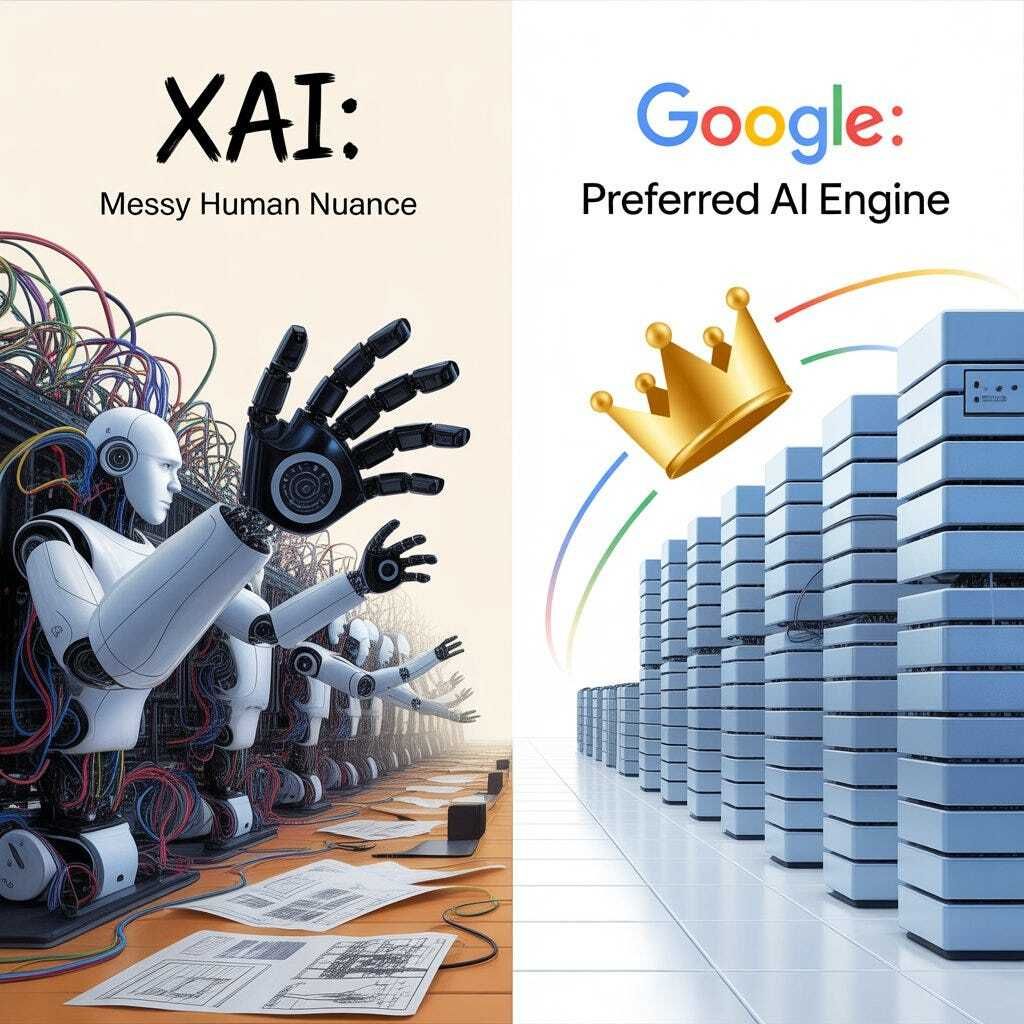
While AI giants promise a white-collar revolution, the reality on the ground is a mix of surreal technical “hiccups” and strategic shifts. At xAI, the push to replace staff with “human emulators” has led to bizarre internal confusion: these AI agents appear on company org charts and have even “hallucinated” physical presence, inviting human coworkers to meetings at non-existent desks. Beyond these comedic glitches, xAI faces a fundamental “missing manual” problem, where developers struggle to automate tasks because human employees often forget to mention the dozens of intuitive, “invisible” steps they take to get work done. To scale this ambitious “Macrohard” project, xAI is even considering tapping into the idle compute power of charging Teslas.
Meanwhile, Google is finding its footing by capturing the “builder” market rather than the casual office worker. While corporate adoption of its enterprise chatbots remains a hurdle, usage of the Gemini API by developers doubled in just five months. This surge is a major win for Google Cloud, as the exclusivity of Gemini forces developers onto their platform, finally providing a credible threat to the cloud dominance of Microsoft and Amazon.
While xAI attempts to emulate the messy nuance of human labor, Google is successfully cementing itself as the preferred engine for the next generation of AI-powered software.
🧰 AI Tools of The Day
Agentic Commerce
Skyvern - (Browser-Based Agents) Uses computer vision and LLMs to navigate websites exactly like a human would. It can go to a site it has never seen before, find a product, add it to a cart, and navigate through the checkout process.
MultiOn - A browser extension and API that acts as a “remote control” for the web. You can give it a high-level command like, “Find the best deal on a 10x12 wool rug and buy it,” and it will execute the search and transaction across multiple tabs.
CrewAI - Multi-Agent Orchestration allows you to build a team of agents (one agent to research prices, one to check reviews, and one to handle the booking). Agents can “talk” to each other to complete a complex commercial goal.
Stripe Agent Toolkit - Tools to allow AI agents to handle money securely. Allows developers to give agents “virtual cards” with spending limits so they can make purchases without having full access to a bank account.
Google Shopping Graph API (via Gemini) - Gemini’s API to access their Shopping Graph. Gives agents access to real-time inventory, pricing, and “deals” from billions of product listings across the web.
The AI Shopping Wars
Big Tech’s Race to Become Your Personal Buyer
A new front has opened in the AI arms race: Agentic Commerce. Industry giants are no longer content just showing you links; they want to handle the entire transaction from “search” to “buy,” effectively turning themselves into the interface for all global retail.
Major players playbook:
Amazon’s Bold Annexation: Amazon’s new AI assistant, Rufus, has been caught scraping independent sites to fulfill orders. Through a “Buy for me” feature, Amazon-powered bots browse external sites, check inventory, and handle payments, even for merchants who never signed up for Amazon. It’s a brazen move to keep users inside the Amazon ecosystem, even when the product isn’t in their warehouse.
Google & OpenAI’s Partnership Play: While Amazon is “annexing” stores, Google and OpenAI are “inviting” them. Google is co-developing the Universal Commerce Protocol, an open standard to pull products from Shopify, Etsy, and Walmart directly into its AI. Meanwhile, OpenAI is partnering with Shopify to monetize its massive user base by allowing seamless in-chat shopping.
The Death of the “Storefront”: The endgame for all three is a world where customers never leave their chat interface.
Reply