- Yaro on AI and Tech Trends
- Posts
- Elon Musk’s $25B TeraFab Megafactory Dream or Reality
Elon Musk’s $25B TeraFab Megafactory Dream or Reality
OpenClaw Sets the New Standard for Autonomous AI Agents

Yaro Celis
March 23, 2026
In partnership with

Your AI tools are only as good as your prompts.

Most people type short, lazy prompts because writing detailed ones takes forever. The result? Generic outputs.
Wispr Flow lets you speak your prompts instead of typing them. Talk through your thinking naturally - include context, constraints, examples - and Flow gives you clean text ready to paste. No filler words. No cleanup.
Works inside ChatGPT, Claude, Cursor, Windsurf, and every other AI tool you use. System-level integration means zero setup.
Millions of users worldwide. Teams at OpenAI, Vercel, and Clay use Flow daily. Now available on Mac, Windows, iPhone, and Android - free and unlimited on Android during launch.
Get in Front of 50k Tech Leaders: Grow With Us
OpenClaw hasn’t just changed how users interact with AI agents; it’s reshaping the entire industry. Major AI companies are now releasing models inspired by or fully compatible with OpenClaw to ensure their users have access to its capabilities. China has embraced it both at an industry scale and among individual users, and this is only the beginning.
The rise of demands for massive computing power is growing, and industry leaders are taking notice. The team behind the TeraFab Megafactory believes existing infrastructure won’t suffice, prompting them to build their own high-performance compute systems. We dive into what the Megafactory is, its goals, and whether they’re achievable. Plus, we provide resources to help you get started with OpenClaw and other powerful AI tools.
Let’s get into it. Stay curious.
Elon Musk’s $25B TeraFab Megafactory Dream or Reality
The TeraFab Vision. Scale and Scope
Key Technical Targets
Two-Pronged Chip Strategy
The three drivers behind the TeraFab
Industry Skepticism and Feasibility Concerns
The biggest barriers
🧰 AI Tools - AI Labor Market Dashboard
OpenClaw Sets the New Standard for Autonomous AI Agents
📚Learning Corner - OpenClaw Docs
Subscribe today and get 60% off for a year, free access to our 1,500+ AI tools database, and a complimentary 30-minute personalized consulting session to help you supercharge your AI strategy. Act now, as it expires in 3 days…
📰 AI News and Trends
OpenAI plans to expand its workforce from 4,000 to 8,000 by the end of the year.
Trump Bans Federal Agencies from Using Anthropic’s AI, ending a $200 million Pentagon contract within six months, but the tech community is with Anthropic.
U.S. Advisory Body Warns China’s Open-Source AI Dominance Threatens American Lead, with roughly 80% of U.S. AI startups now reportedly using Chinese open-source models.
The Trump administration released its long-awaited National Policy Framework for AI, urging Congress to prioritize child protection, anti-fraud measures, and innovation while pushing to preempt a fragmented patchwork of state-level AI laws.
OpenAI Plans Launch of Desktop ‘Superapp’ to Refocus and to Simplify User Experience
Other Tech News
Defense tech startup Anduril Breaks into the Pentagon’s Big Leagues with $20B Army Contract, signaling a seismic shift in how the Pentagon procures technology, favoring VC-backed software-first platforms over traditional defense primes.
Kalshi Cinches $22 Billion Valuation in Ongoing Round.
Tesla Finally Has Its First Semi-Truck, and It’s Already a Hit With Truckers.
Amazon plans smartphone comeback more than a decade after Fire Phone flop.
Elon Musk’s $25B TeraFab Megafactory Dream or Reality

On March 21, 2026, Elon Musk unveiled TeraFab, a joint venture between Tesla, SpaceX, and xAI to build what he claims will be the “largest chip manufacturing facility ever.” Located in Austin, Texas, the $25 billion project aims to produce a staggering 1 terawatt of computing power annually. The facility is designed to manufacture chips for both terrestrial applications (Tesla’s AVs and Optimus robots) and space-based orbital data centers.
While the announcement aligns with Musk’s grand vision of vertical integration and securing supply chains for his AI empire, it has been met with profound skepticism from semiconductor industry experts and financial analysts. The sheer technical complexity of leading-edge chip fabrication, combined with Tesla’s lack of manufacturing experience in this domain, makes TeraFab a huge gamble.
Musk’s decision to enter the notoriously difficult semiconductor manufacturing business is driven by a combination of supply chain anxieties, massive compute requirements, and financial engineering.
The TeraFab Vision. Scale and Scope
Musk’s presentation outlined a facility that would consolidate every stage of semiconductor production under one roof: chip design, lithography, fabrication, memory production, advanced packaging, and testing.
Key Technical Targets
Initial Output: 100k wafer starts/month - A typical large-scale modern fab produces ~50,000 wafers/month.
Full Capacity: 1M wafer starts/month - Roughly 70% of TSMC’s entire current global output.
Compute Output: 1 Terawatt/year - 100-200 GW for Earth (Tesla/xAI); 800+ GW for space (SpaceX).
Estimated Cost: $20B - $25B - TSMC spent $165B for six fabs in Arizona; a single 50k-wafer 2nm fab costs ~$28B.
Two-Pronged Chip Strategy
TeraFab is slated to produce two distinct categories of chips:
Terrestrial Inference Chips: Designed for Tesla’s “Full Self-Driving” (FSD) software, the Cybercab robotaxi program, and the Optimus humanoid robot line.
Orbital AI Chips (D3): Custom-designed for space. Musk stated that 80% of TeraFab’s compute output would be directed toward space-based orbital AI satellites. He argued that solar irradiance in space is 5x greater than on Earth, and the vacuum allows for efficient heat rejection, potentially making orbital AI compute cheaper than terrestrial alternatives within 2-3 years.
The three drivers behind TeraFab:
1. Compute shortage is the core driver
Elon Musk claims current fabs meet only ~2% of future demand
xAI already runs hundreds of thousands of GPUs (largely from Nvidia)
AI scaling = exponential compute needs → supply can’t keep up
2. Full vertical integration strategy
Today: dependent on Nvidia + foundries like TSMC and Samsung
Goal: control design → manufacturing → deployment across cars, robots, and satellites
Outcome: reduced dependency + tighter optimization
3. IPO narrative and timing
Tesla facing 2 years of declining sales (2025)
SpaceX + xAI tied to a potential $1.75T IPO valuation
TeraFab reframes the story: from auto slowdown → AI infrastructure powerhouse
Industry Skepticism and Feasibility Concerns
Building a leading-edge fab is one of the hardest engineering challenges globally
Tesla has chip design experience, but zero manufacturing experience
Experts like Jensen Huang emphasize that it requires deep expertise across science, engineering, and precision processes
At the 2nm level, complexity explodes:
Requires atomic-scale control (lithography, etching, yield optimization)
Incumbents like TSMC, Samsung, and Intel have spent decades + $100B+ building this capability
The biggest barriers to Tesla’s “TeraFab” are capital, supply chain, and talent.
Cost gap: Morgan Stanley estimates ~$45B for a top-tier fab vs. ~$25B projected by Elon Musk
Equipment bottleneck: Access to EUV machines from ASML can take years for new entrants
Talent shortage: Skilled fab engineers are scarce; leaders like TSMC already relocate global teams to operate fabs
TeraFab could reshape the $600B+ semiconductor industry, but execution risk is extreme. Even analysts like Stacy Rasgon argue it may be harder than missions to Mars, highlighting how unrealistic near-term success may be.
📚Learning Corner
📘 OpenClaw Docs – core reference for setup, integrations, skills, and how the agent engine works.
OpenClaw Sets the New Standard for Autonomous AI Agents

OpenClaw has rapidly reshaped the AI landscape, creating a wave of open-source, persistent AI agents that run on local or cloud hardware. Its viral adoption forced major players to adapt offerings and strategies to keep up.
Key points:
OpenClaw agents run 24/7, integrate with tools and messaging apps, and maintain long-term memory, enabling automated workflows.
NVIDIA, AWS, Anthropic, and OpenAI are responding with their own agent-focused platforms (NemoClaw, Lightsail OpenClaw instances, Claude Code Channels, Frontier).
Business impact includes new revenue streams, shifts in pricing models, and the need for enterprises to adopt secure agent deployment, MLOps practices, and governance frameworks.
Risks involve data security, regulatory scrutiny, and ethical concerns around autonomous AI actions.
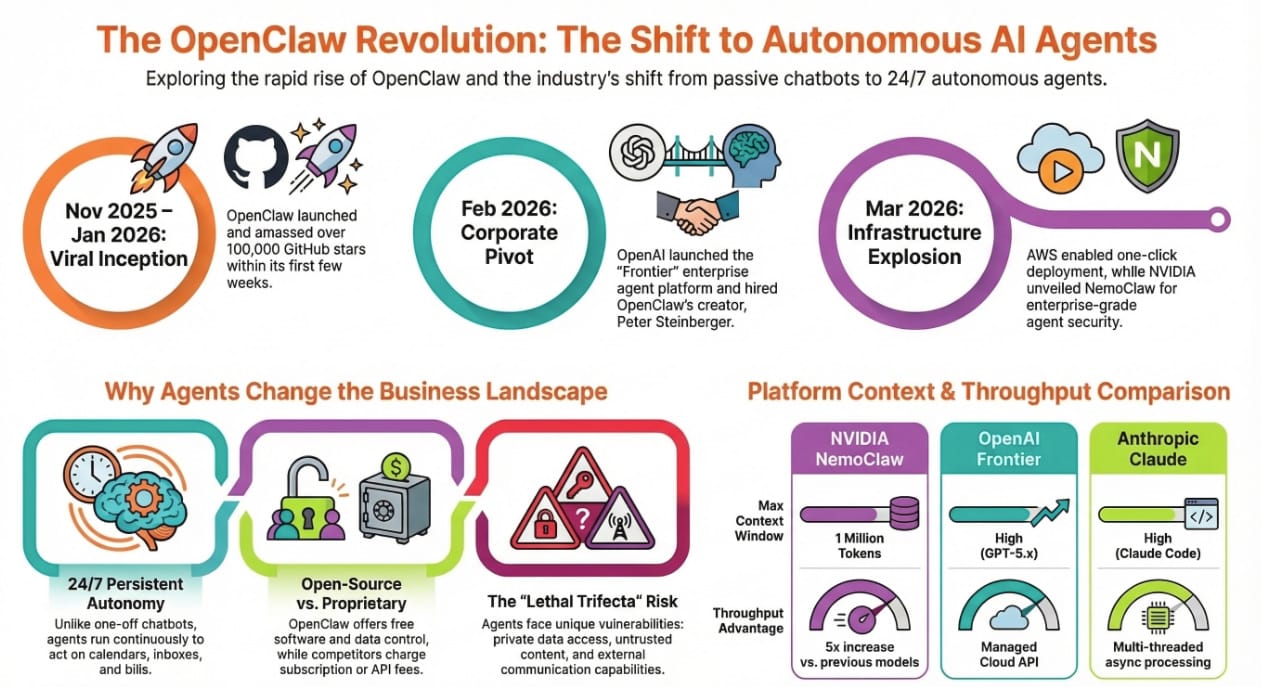
OpenClaw essentially turned AI agents into a new standard for productivity, automation, and enterprise adoption.
🧰 AI Tools of The Day
I built a local AI Labor Market Dashboard using Python and Streamlit, based on Anthropic’s March 2026 Economic Index research on which jobs are actually being disrupted by AI (not just theoretically, but in practice). It lets you explore:
Which occupations have the highest real-world AI exposure
Where hiring is collapsing for 22–25 year olds post-ChatGPT
How 10-year BLS job growth projections correlate with AI risk
A coverage gap chart showing how far actual adoption lags behind AI’s theoretical reach
The data is seeded from the paper, but the framework is wired to accept live BLS API data.
Reply