- Yaro on AI and Tech Trends
- Posts
- 👩💻Move Over Vibe Coding "Agentic engineering" is here.
👩💻Move Over Vibe Coding "Agentic engineering" is here.

Yaro Celis
February 09, 2026
In partnership with

Get in Front of 50k Tech Leaders: Grow With Us
Here is what we have today, team:
My Conversations with Caltech Data Architect about coding, SQL, and Humble engineers.
Move Over Vibe Coding Agentic engineering is here.
🧰 AI Tools - Generative Video & World-Model Architectures
What is the Key to Physical AGI?
📚Learning Corner - Reinforcement learning.
Subscribe today and get 60% off for a year, free access to our 1,500+ AI tools database, and a complimentary 30-minute personalized consulting session to help you supercharge your AI strategy. Act now as it expires in 3 days…
Start learning AI in 2026

Everyone talks about AI, but no one has the time to learn it. So, we found the easiest way to learn AI in as little time as possible: The Rundown AI.
It's a free AI newsletter that keeps you up-to-date on the latest AI news, and teaches you how to apply it in just 5 minutes a day.
Plus, complete the quiz after signing up and they’ll recommend the best AI tools, guides, and courses — tailored to your needs.
📰 AI News and Trends
Meta AI readies Avocado, Manus Agent, and OpenClaw integration.
How Nvidia became the first $5 trillion company.
Crypto.com founder buys AI.com in ‘largest domain purchase in history’
The 2026 Super Bowl advertisements took it a step further by leveraging AI both to create the commercials and to promote the latest AI products
Other Tech News
Africa’s biggest mining conference opened in Cape Town, a gathering set to be dominated by US-China competition for the continent’s valuable resources.
SpaceX is exploring a “Starlink Phone” for direct-to-device internet services, and they are shifting all focus to conquering the moon.
Apple Prepares to Kick Off 2026 With the iPhone 17e, New iPads, and Macs.
Is this the first real crypto crash?
My Conversations with Caltech Data Architecture.
Vibecoding, future-proofing your career, data, SQL, humble engineers and more.

I had the pleasure to sit down with and interview, Armando Plasencia, Caltech Data Architect with 25 years of experience in the Data and Tech world. While chatting, he shared that long-term success in tech will be driven less by mastering specific tools and more by curiosity, humility, and community.
He stresses that engineers must keep learning daily as AI automates routine coding, while strong collaboration and openness to feedback now outperform solo expertise. Plasencia highlights open-source as a fast-track career path, noting that contributors gain real-world experience with software used by hundreds of thousands of companies and build trusted professional networks. He also points to low-code and no-code platforms that can reduce development from months to minutes, shifting software creation toward business logic rather than syntax, while emphasizing SQL and data sovereignty as critical skills in an AI-driven era. This is the entire conversation, and we will be uploading shorts on our Substack Notes account.
Move Over Vibe Coding Agentic engineering is here.

A year ago, although it seems many more than that, Andre Karpathy coined the term Vibecoding. During that year we have seen apps like cursor more than 10x in value and usage, and other apps like lovable and repplit become darlings for any one wanting to build apps but lacking coding knowledge. The hype of prompting AI to build Apps and create code is now in the past and we are moving to Agentic Engineering, a new term coined by Andre as well, which is the act of AI coding itself.
Researchers have demonstrated that large multi-agent AI systems can now run for days with minimal human input, generating ~1,000 software commits per hour and executing 10+ million actions while building and maintaining complex products like a web browser.
This signals the rise of “self-driving codebases,” where AI increasingly designs, writes, tests, and fixes software on its own, a trend that could automate 80%+ of enterprise development within five years and cut software costs by 50–70%. While this does not yet qualify as full AGI, it shows early AGI-like behavior in narrow domains such as engineering, with systems capable of long-term planning, self-correction, and collaboration. As technology begins to build itself, human value will shift toward problem framing, system design, and governance rather than manual coding, making these skills essential for today’s youth. At the same time, cybersecurity risks will rise sharply, as autonomous systems can discover and exploit vulnerabilities in hours, enable self-evolving malware, and amplify supply-chain attacks, meaning future digital security will depend as much on controlling AI behavior as on defending traditional infrastructure.
📚Learning Corner
Reinforcement Learning: An Introduction – Sutton & Barto
How agents learn from interaction
Model-based vs model-free learning
Planning with learned world models
How prediction + control work together
What is the Key to Physical AGI?
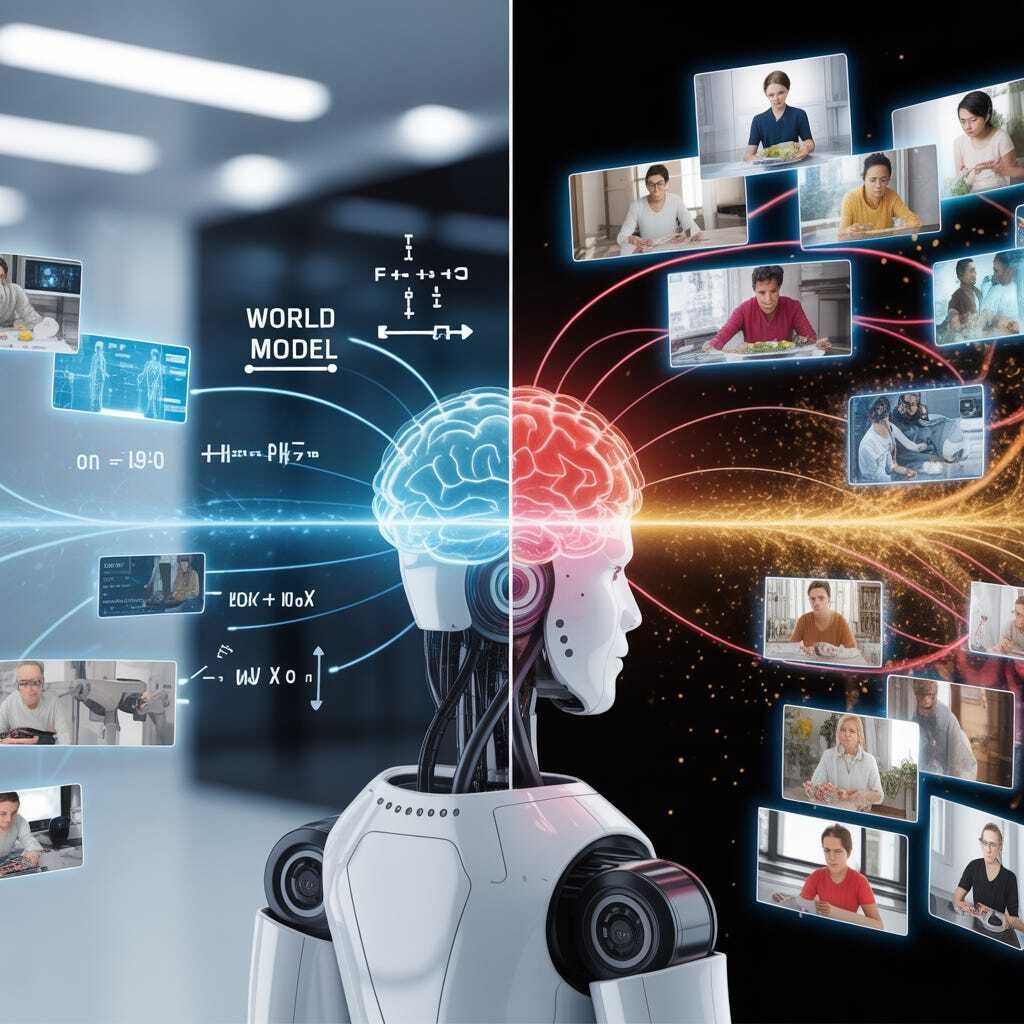
Robots Will Learn Like Humans. Data, Not Hardware, Is the Key to Physical AGI
Researchers argue that the main barrier to achieving Physical AGI in robotics is not hardware or algorithms, but data, as today’s robots are trained on only thousands of hours of controlled demonstrations compared to the billions of human-years behind modern language and vision models. The only scalable solution is capturing massive amounts of human egocentric video, potentially 100+ million hours, equivalent to 150 lifetimes of experience, and using it to train “world models” that learn physics, cause-and-effect, and task dynamics by predicting how scenes evolve over time.
By learning from human experience first and then transferring that knowledge to robots, early systems like DreamZero have already shown 40%+ performance gains from just minutes of video data, suggesting that robots can acquire general physical intelligence with minimal retraining. This approach favors humanoid or human-like machines, which reduce the gap between human and robot movement, and points to a future where robots learn primarily by watching people rather than being manually programmed.
If successful, this paradigm could enable robots to perform complex real-world tasks with little supervision, marking a realistic path toward Physical AGI driven by large-scale human experience rather than handcrafted robotics data.
🧰 AI Tools of The Day
Generative Video & World-Model Architectures
V-JEPA (Video Joint Embedding Predictive Architecture) – a state-of-the-art world model trained on video that excels at visual understanding and prediction, useful as a backbone for world modeling tasks.
DeepMind’s Genie 3 – advanced world model for generating dynamic interactive environments from text, which can serve as simulated training data for robots and embodied agents.
MorphoSim – a language-guided 4D simulator that creates controllable spatiotemporal worlds for training and evaluating world models and embodied agents.
Reply