- Yaro on AI and Tech Trends
- Posts
- 🧠 The DRAG Method - How to Use AI to Upgrade Your Brain.
🧠 The DRAG Method - How to Use AI to Upgrade Your Brain.
Plus: Are Small Nuclear Reactors the Solution?

Yaro Celis
February 05, 2026
In partnership with

Get in Front of 50k Tech Leaders: Grow With Us
Today, we share a step-by-step guide to the DRAG method, a practical way to use AI to make you smarter and more focused, instead of fueling digital “brain rot.” We also break down how small modular nuclear reactors could reshape clean energy, and highlight the best tools and learning resources for building AI agents in 2026.
The DRAG Method - How to Use AI to Upgrade Your Brain.
🧰 AI Tools
Are Small Nuclear Reactors the Solution?
📚Learning Corner - AI Agents from Scratch
Subscribe today and get 60% off for a year, free access to our 1,500+ AI tools database, and a complimentary 30-minute personalized consulting session to help you supercharge your AI strategy. Act now as it expires in 3 days…
📰 AI News and Trends
How Anthropic achieved AI coding breakthroughs and rattled business.
Why Big Tech Is Throwing Cash Into India in Quest for AI Supremacy.
Gizmo, an interactive model that vibes code mini apps, is all the rage. Simply type out an AI prompt to explain your idea using natural language. The app turns your idea into an interactive experience by generating the code that makes it work.
Google Gemini has surpassed 750 million monthly active users. MetaAI has ~500 million monthly users, and ChatGPT has ~810 million.
Meta's Avocado vs. Kimi K2.5. Meta’s model reportedly outperforms top open-source base models. Kimi K2.5 is a solid model and exceeds expectations, making it an excellent choice for developers who can't afford or don't want to pay for Opus 4.5 and have to go with something cheaper to run their OpenClaw.
OpenAI in Talks to Power Amazon’s Alexa, Other AI Products.
An AI model developed by Google DeepMind is giving athletes new insights into how their bodies move by using AI 3d Videos to analyze their techniques.
Other Tech News
Artificial snow is a short-term solution as climate change threatens the future of the Winter Olympics.
First-ever experimental gene therapy seeks to restore vision by rejuvenating eye neurons.
AT&T to use Amazon Leo, the e-commerce giant’s low Earth orbit satellite network, to deliver fixed broadband services to businesses.
Start learning AI in 2026

Everyone talks about AI, but no one has the time to learn it. So, we found the easiest way to learn AI in as little time as possible: The Rundown AI.
It's a free AI newsletter that keeps you up-to-date on the latest AI news, and teaches you how to apply it in just 5 minutes a day.
Plus, complete the quiz after signing up and they’ll recommend the best AI tools, guides, and courses — tailored to your needs.
Are Small Nuclear Reactors the Solution?
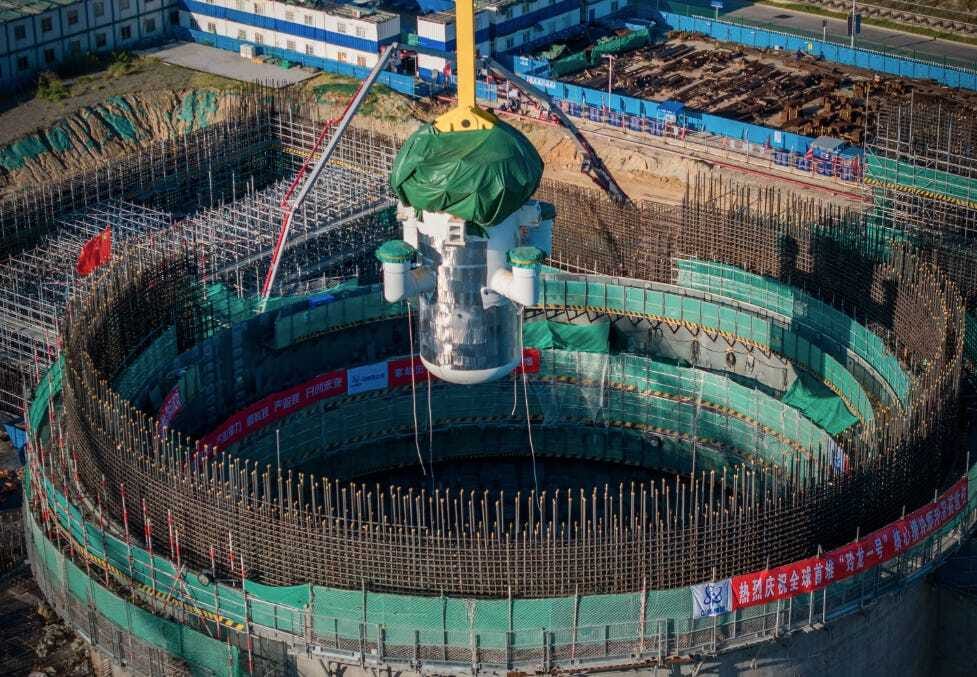
China’s Linglong One, the world’s first land-based commercial small modular reactor, should come online in 2026. Construction crews installed the core module in August 2023.
Next-generation nuclear reactors are breaking away from the massive, slow, and expensive 20th-century model by going smaller, safer, and more efficient. New small modular reactors (SMRs) can be factory-built, installed faster, and scaled as needed, cutting construction risk and potentially lowering costs. Advanced fuels like HALEU (5–20% U-235) and TRISO particles can run longer between refueling and withstand temperatures above 3,200°F (1,800°C), improving safety.
Meanwhile, alternative coolants like molten salt, liquid metal, and gas allow reactors to operate above 500°C, versus ~300°C for water, boosting efficiency while reducing high-pressure risks. With global electricity demand rising from AI data centers, climate systems, and industrial electrification, these designs aim to deliver clean, reliable power faster if they can prove they’re truly cheaper and scalable.
📚Learning Corner
Github AI Agents resource - A curated collection of resources for studying AI agents updated regularly to help you understand, build, and evaluate autonomous AI/LLM agents.
The DRAG Method
How to Use AI to Upgrade Your Brain.
Using AI correctly may not be as simple as we think. Most people are getting very lazy and relying on language models to do their thinking for them, and as the saying goes, “if you don't use it, you will lose it.” We are utilizing our brains less and less as technology provides us with powerful tools that don’t require much thinking on our part, but if we use them wisely, we can actually get more out of them, which will allow us to become brighter and mentally sharper.
That is when AI becomes a thinking amplifier; it takes your low-value cognitive load, sharpens your reasoning, and helps you move faster on the work that actually compounds.
The 4-Step Framework
Step 1 — DRAG the “Zone 1” Work Off Your Plate
Think of your work in two zones:
Zone 1 = low-stakes, repeatable tasks.
Zone 2 = high-stakes, high-leverage thinking.
The goal is to delegate Zone 1 to AI so you can obsess over Zone 2.
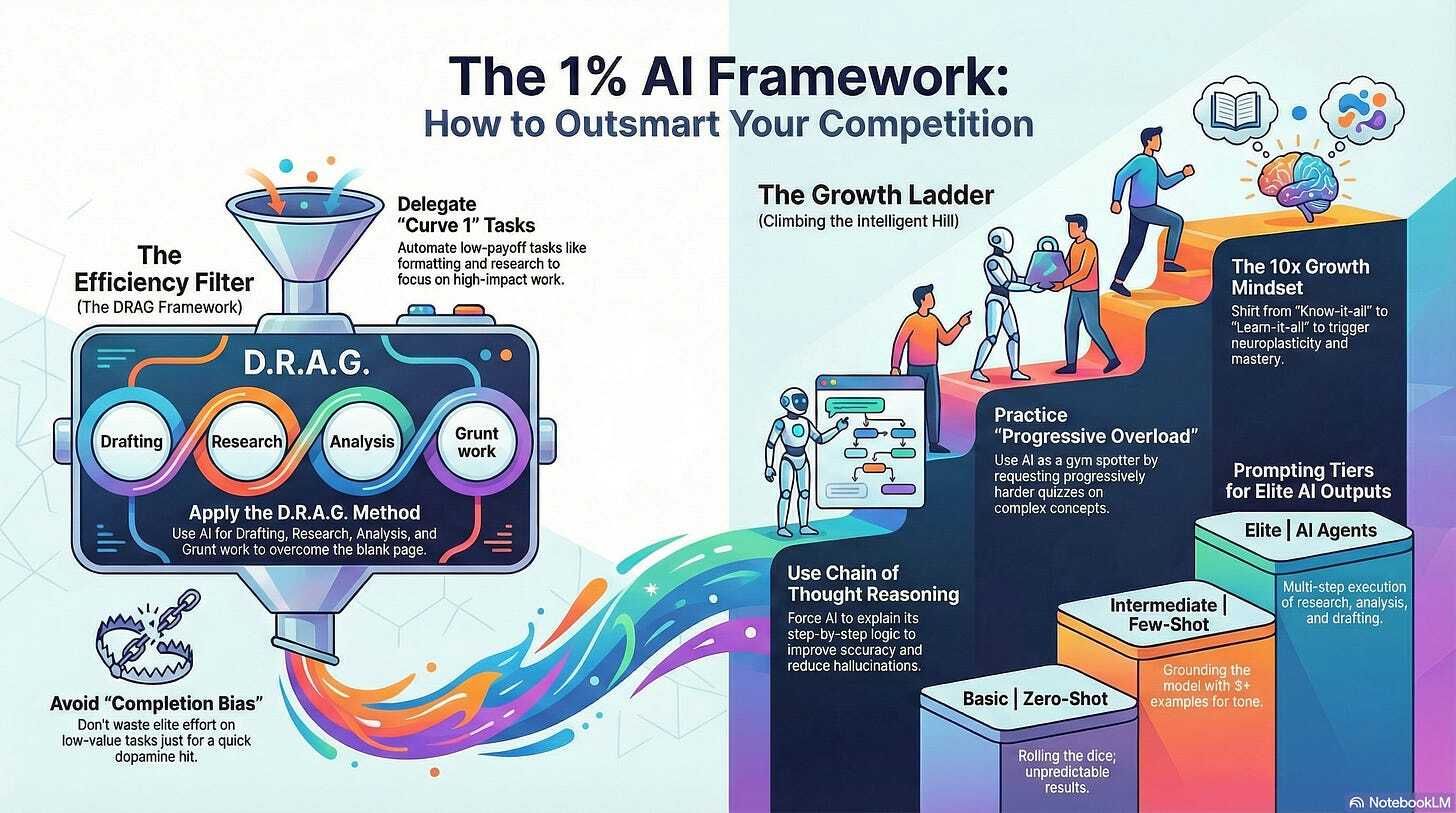
Use DRAG to offload the mundane:
D — Drafting: first drafts, outlines, emails, post versions
R — Research: summaries, citations, competitive scans, trend maps
A — Analysis: pros/cons, frameworks, comparisons, decision memos
G — Grunt Work: formatting, tables, checklists, SOPs, rewriting
Weekly win condition: if AI doesn’t save you 3–10 hours/week, you’re under-delegating.
Prompt: “This is Zone 1 work. DRAG it for me: Draft + Research + Analyze + Grunt. Output as bullets, then a clean final.”
Step 2 — Climb the Intelligent Hill (Stop “Hope-and-Pray” Prompting)
Most people do zero-shot prompting:
“Write me a thing about X.” That’s basically: “Guess what I want.”
Instead, climb the “intelligent hill” through 4 levels. Each level increases quality and reduces hallucinations.
Camp 1 — One-shot Prompting
Give one example of what “good” looks like. Use it when you want a specific style (newsletter, LinkedIn, pitch deck tone).
Prompt: “Write this in the same style as the example below. Match structure, tone, and length. EXAMPLE: [paste the example]”
Camp 2 — Few-shot Prompting
Give 3+ examples so it can learn patterns. Use it when you want a consistent brand voice across a whole system.
Prompt: “Before you write, explain the pattern you see across these examples in 5 bullets.”
This forces clarity and reveals your own “hidden rules.”
Camp 3 — Chain-of-thought Reasoning (Slow the model down)
The goal is to reduce sloppy output by forcing explicit reasoning. This is used when stakes are higher (strategy, analysis, numbers, decisions).
Prompt: “Ask me 3 clarifying questions, then propose 3 options. For each option: assumptions, risks, and why it’s likely to work. Then write the final output.”
Camp 4 — Agents (AI as a team)
Treat AI like multiple specialists, not one chatbot. You can use this when researching → synthesizing → writing in one flow.
Prompt: “You are a team: Researcher, Analyst, Editor. Researcher: gather key points + evidence. Analyst: extract the 5 implications and 3 contrarian angles.
Editor: write a clean newsletter in my tone with a strong hook.”
Before you hit enter, try asking this to see the results:
“Can I upgrade this prompt one camp higher?”
Step 3 — Build the Intelligent Gym (AI as Your Spotter)
A “spotter” doesn’t lift for you. They are safe resistance so you get stronger.
Use AI to force higher-quality thinking:
Ask it to attack your logic
Ask it to steelman the opposite
Ask it to find missing variables
Ask it to create quizzes for your beliefs
Prompt: “Challenge my assumptions, point out weak reasoning, and propose the smallest test I can run this week to validate this idea.”
Step 4 — Use the Fool’s Advantage (Learn-it-all Mode)
The “fool’s advantage” is the willingness to look dumb long enough to get smart. AI makes that cheap. Instead of avoiding hard topics, you can:
compress months of confusion into 30 minutes.
learn the basics, then climb to advanced.
get analogies, examples, and mini quizzes.
“Explain this like I’m 12, then like I’m a college student, then like I’m a domain expert. After each level, quiz me with 5 questions.”
Please share your experience using the drag method and whether it has become beneficial.
Your Payment Processor Is Hiding Your Revenue Leaks

Most businesses think churn = cancellations. - That’s wrong.
What your payment processor doesn’t clearly show you:
Failed payments silently kill 5–9% of revenue
Customers at risk before they cancel
Which products actually drive churn
How much revenue could be recovered every month
We built a real-time financial command center on top of Stripe and any payment processor that shows:
MRR, Net Revenue, Churned MRR
Revenue by product & customer
Subscription risk alerts
Failed payment recovery tracking
Client lifetime value & tenure
If you do $20k+/month, you’re almost certainly leaving money on the table.
🧰 AI Tools of The Day
AI Agents - Easy Apps to start with.
Copilot Studio - Complex multi-step AI workflows.
Zapier AI - Business automation with apps.
Notion AI - Personal and team productivity.
Explore our AI Guides — from coding to photography and beyond, and find step-by-step tips to put AI to work for you.
Reply